What is Evolution?
For Charles Darwin, evolution was the process by which selection causes changes in the frequency of traits of individuals in a species over generations. Based on the work of the economist Malthus, he proposed that organisms produced more offspring than the environment could support, resulting in “survival of the fittest”, i.e. selection of offspring with traits that gave them an advantage. Over time, changes can accumulate to the point that different populations diverge enough to become separate species. The members of one population cannot mate and produce viable offspring with members of another population once they are separate species. While this idea has stood the test of time, his concept of how traits were passed on to offspring did not. He proposed that every part of the body emitted “gemmules” which carried information about traits. Those collected in the reproductive organs, then were shared in mating to produce a “blended” inheritance of the parental traits. This reflecting prevailing views of his time. There might also have been hints of Lamarckism, the idea that traits acquired during a lifetime could be passed to offspring. The lack of a clear mechanism of inheritance was a weakness in his theories, but he’s still considered the founder of evolutionary biology.
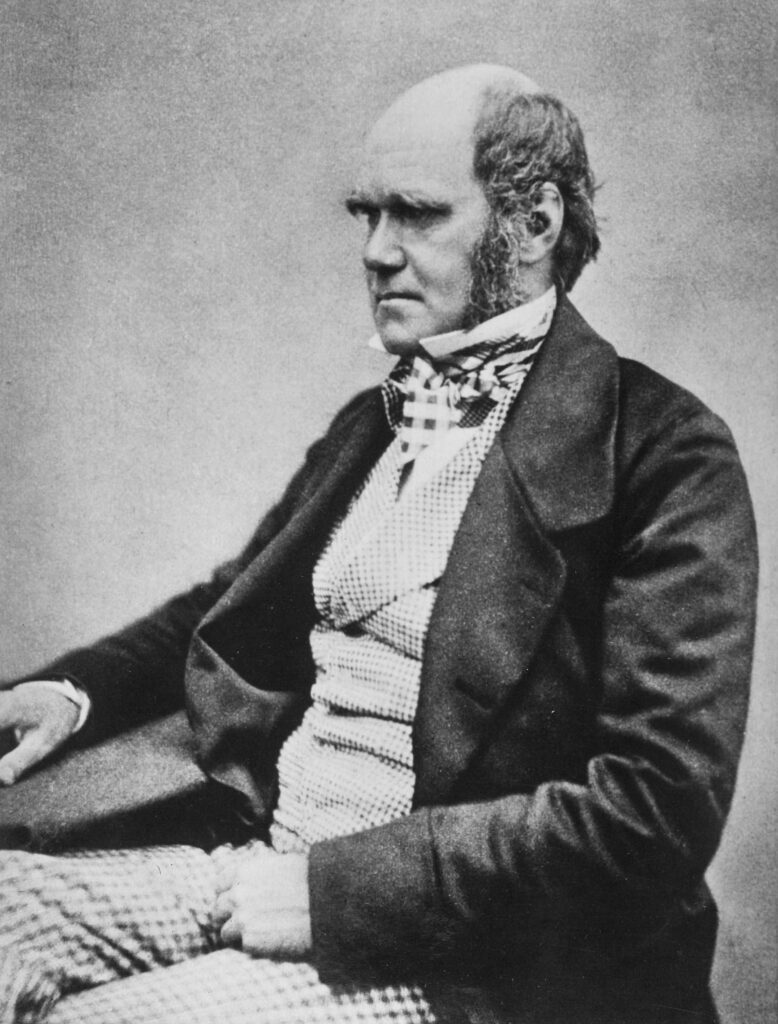
Charles Darwin (1809-1882) was a remarkable scientist. He was the son of a wealthy English family at the height of the British Empire. Thanks to his family’s wealth, he was able to spend his life pursuing his considerable curiosity. He was a keen observer of the natural world, interested in geology and biology. He wrote constantly, making notes and sharing information in letters, articles and books. He communicated with everyone around him, sharing and listening. In his youth, he spent 5 years on the H.M.S. Beagle (1831-1836), a research vessel that circumnavigated the globe in the southern hemisphere, surveying and collecting specimens. His accounts of that voyage propelled to him to lifelong fame. What he observed on the voyage, combined with years of additional observation, absorbing the ideas of other scientists of his day, and his own synthesis with his ideas, led him eventually to the publication of the book “On the origin of species by means of natural selection, or, The preservation of favoured races in the struggle for life” in 1859, which is arguably the foundation of modern biology. Darwin published many other writings during his life. He also married his cousin Emma Wedgwood. They had 10 kids, three of whom died before adulthood. He was a devoted parent. Darwin was a good athlete in his youth, albeit with some problems with shyness, a touchy stomach, and some eczema. After the voyage of the Beagle he began to suffer more serious health issues that made him a reclusive invalid. He finally succumbed to heart problems at age 73.
As Darwin was writing and publishing “On the Origin of Species” Gregor Mendel, a monk in Moravia in Europe, was mapping the mechanics of inheritance. Seven years after Darwin’s book came out, Mendel published Experiments in Plant Hybridization (1866). In it, he described methodical, quantitative breeding experiments with 28,000 pea plants, which he began in 1954. From that work, he proposed than inheritance is “particulate” based on discrete factors rather than blending of parental traits. The factors he studied, most notably flower color were either dominant or recessive. If either parent passed a dominant factor to an offspring, the flower was that color. Only if both parents passed down a recessive trait was the recessive color expressed in offspring flowers. This is the basis of what we now call genetics, although the term “genes” wasn’t proposed until 1909 by Wilhelm Johansen.
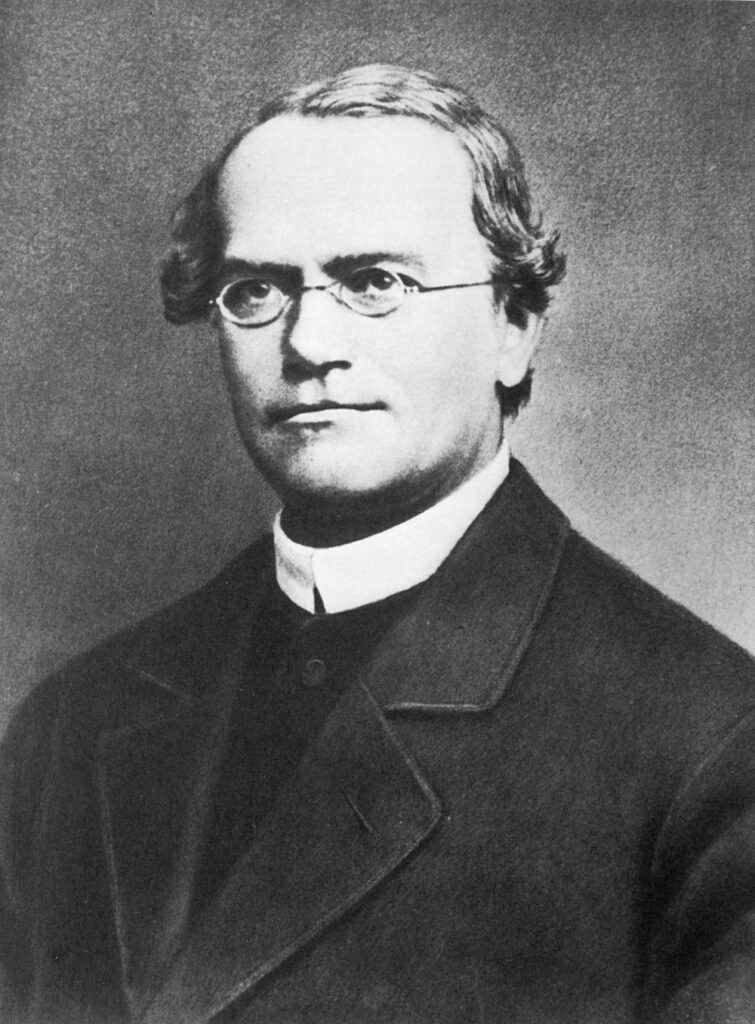
Gregor Mendel (1822-1884) was also an accomplished scientist, albeit from somewhat different origins than Darwin. Mendel was bon to a German-speaking family with a small farm in Heimzendorf, Silesia, when it was part of the Austrian Empire. He joined the Augustinian Order as monk in 1843, partly because they would pay for his education. He was ordained as a priest in 1847. He studied physics, mathematics, and botany at the Universities of Olmütz and Vienna. Through his monastery Altbrünn in Brünn, the capital of Moravia he was a teacher for many years, then became abbot of monastery in 1867. His abbot allowed him to do hybridization studies in the monastery garden, despite some discouraging words from his abbot after the bishop giggled when informed of the plan to study the genealogies of peas. The bishop flat disallowed his project to study crossing in mice because at was unseemly to study animal mating. Mendel published papers on hawkweed, meteorology and climatology, crop pests, and beekeeping. Throughout his life he suffered from physical and mental health problems. He was unable to pass the oral exams for teaching, probably because they were too stressful. After he became abbot, his scientific work largely stopped, superseded by his administrative duties. He continued as abbot until his death from chronic nephritis (kidney failure).
Natural selection and inheritance are the cornerstones of evolutionary theory, but were received very differently when they were presented in Darwin’s book and Mendel’s article respectively.
Natural selection was an idea whose time had come. Many in science were thinking about the concept. Darwin gave voice to that school of thought, with more evidence and exposition than anyone else. His book was well received, although by no means universally accepted. In fact, his friend Alfred Russel Wallace sent Darwin a draft article describing natural selection. With the help of their circle of academic friends, they co-presented the paper “On the Tendency of Species to form Varieties; and on the Perpetuation of Varieties and Species by Natural Means of Selection” at the Linnean Society of London on July 1, 1858, then published on August 20, 1858. Here’s that paper.
In contrast, Gregor Mendel’s article was entirely his work, without a network of friends promoting it in scientific circles. It countered the prevailing paradigm of blended inheritance. Instead Mendel clearly demonstrated that the discrete traits he measured had discrete i.e. “particulate” inheritance factors. Experiments in Plant Hybridization was quite quantitative, with equations explaining the distribution of traits. It was read at the meeting of the Brünn Natural History Society in 1865, then published in the society’s journal. Here’s an English translation from the original German done by William Bateson in 1901.
Both articles are solid 19th Century science, but the articles and Darwin’s subsequent book “On the Origin of Species” were received very differently. Many embraced Darwin’s synthesis. Mendel’s work was ignored. His work wasn’t rediscovered until 1900, when three well-known scientists in botany and genetics independently reported similar hybridization results. They claimed not to have known about Mendel’s work, although 2 had read it but forgotten. All admitted the Mendel came first, once it was pointed out. William Bateson, who founded and named the science of genetics, found Mendel’s article in 1900, then made the translation shown above. He began translating that, then spent the rest his career building on Mendel’s work with more experiments. Bateson coined the word genetics in 1909.
There’s no sign Darwin knew of Mendel’s work, but Mendel owned a copy of “On the Origin of Species.” There are clear indications Mendel accepted the concept of evolution. One can’t help but wonder how Darwin would have responded to Mendel’s Experiments in Plant Hybridization. If he had read it, grasped it, and supported the idea of particulate inheritance (genetics), what became the Modern Synthesis of the 20th Century might have gotten started 35 years earlier.